
Diabetes Self-Advocacy: Turning Daily Data Into Better Care
Key Takeaways
- Black women with type 2 diabetes often face systemic challenges and biased healthcare, making strategic self-advocacy essential.
- Utilize the ROOT Framework to enhance your care by revealing beyond just glucose numbers, including emotional and lifestyle factors.
- During medical appointments, actively offer observations and specific needs to shift from passive to engaged care.
- Adequately request health screenings and culturally sensitive support to ensure your care aligns with your experiences.
- Implement the Loop-Back method to verify that your care plan is tailored to your needs; your lived experience matters in diabetes self-advocacy.

For many Black women living with type 2 diabetes, the morning ritual begins with a single number on a glucose monitor. While that number is a vital clinical metric, it is often treated as the only metric that matters. It’s important to remember that diabetes self-advocacy can play a crucial role in navigating life with this condition.
However, “good numbers” on a screen do not always reflect the full complexity of a woman’s lived experience—her stress levels, her sleep quality, or the invisible weight of navigating a healthcare system that often fails to see her clearly. At Rooted in Violet & Co., we believe that Knowledge is Protection. To move beyond reactive care, we must reposition ourselves as the Architects of our own health journeys, transforming daily data into a powerful tool for systemic advocacy.
The Burden of the Unseen: Why Standard Care Often Fails
In the United States, Black women experience disproportionately high rates of type 2 diabetes and cardiovascular mortality. This is not a personal failure; it is a systemic one. Traditional diabetes self-management education (DSMES) often fails when it is not culturally aligned—ignoring the intersectional burdens of medical bias, food sovereignty, and the “weathering” effect of chronic stress.
When care plans are standardized rather than personalized, the “disconnect” occurs: clinicians may focus on a single A1C lab result while ignoring the patient’s report of burnout or financial barriers to medication access. Strategic self-advocacy is the intervention required to bridge this gap.
Using the ROOT Framework for Diabetes Mastery
To move from uncertainty to strategic action, we utilize the ROOT Framework to structure every clinical encounter.
1. R – Reveal What’s Going On (Beyond the Fingerstick)
Self-advocacy begins with data, but we must expand our definition of “data”. While tracking glucose is essential, the ROOT Framework encourages you to establish pattern recognition by logging:
- Emotional Burnout: Are you experiencing “diabetes distress”?
- Sleep Patterns: How does a poor night’s sleep impact your morning fasting numbers?
- Stress Triggers: Notice if work or caregiving stress causes spikes, even when your diet remains consistent.
- Lifestyle Context: Document how your body responds to cultural foods or specific exercise routines.
Strategic “So What?”: Presenting these logs during an appointment ensures your concerns are treated as rigorous clinical data that demands investigation, mitigating the risk of “symptom masking”.
2. O – Offer Your Observations
During your appointment, shift from a passive recipient of information to an active contributor. Instead of waiting for the doctor to ask how you feel, offer your specific findings:
- “I’ve noticed my glucose remains high even when I follow the meal plan, but only on days when my stress levels are at a seven or higher.”
- “I am experiencing significant fatigue in the afternoons that doesn’t seem to align with my carb intake.”
3. O – Outline What You Need
This is where you reclaim control over the care trajectory. Diabetes management requires a comprehensive team. Do not hesitate to request specific screenings or referrals:
- Kidney Screening: Request a UACR (urine albumin-creatinine ratio) and GFR (glomerular filtration rate) annually.
- Foot Exams: Ensure your provider performs a comprehensive foot exam at every visit, not just a quick glance.
- Culturally Sensitive Support: Ask for a referral to a Registered Dietitian (RD) or a Diabetes Care and Education Specialist (CDCES) who understands African American dietary patterns and the importance of soul food as a cultural cornerstone.
4. T – Take Note & Follow-Up
Establish a longitudinal paper trail to prevent medical “gaslighting”. Document the provider’s responses to your requests. If a provider denies a requested test, ask them to document the refusal and the clinical reasoning in your chart—this often prompts a reconsideration of the request.
The “Loop-Back” Script for Culturally Tailored Care
One of the most effective tools for ensuring Radical Transparency is the Loop-Back method. Use this script to verify that the care plan actually fits your life:
You: “To make sure I understand, you are recommending I increase my dosage of [Medication Name] and walk 30 minutes daily. However, we haven’t discussed how my current work schedule impacts my ability to exercise safely at night. Can we look at a plan that accounts for my actual environment?”
Summary Checklist for Your Next Visit
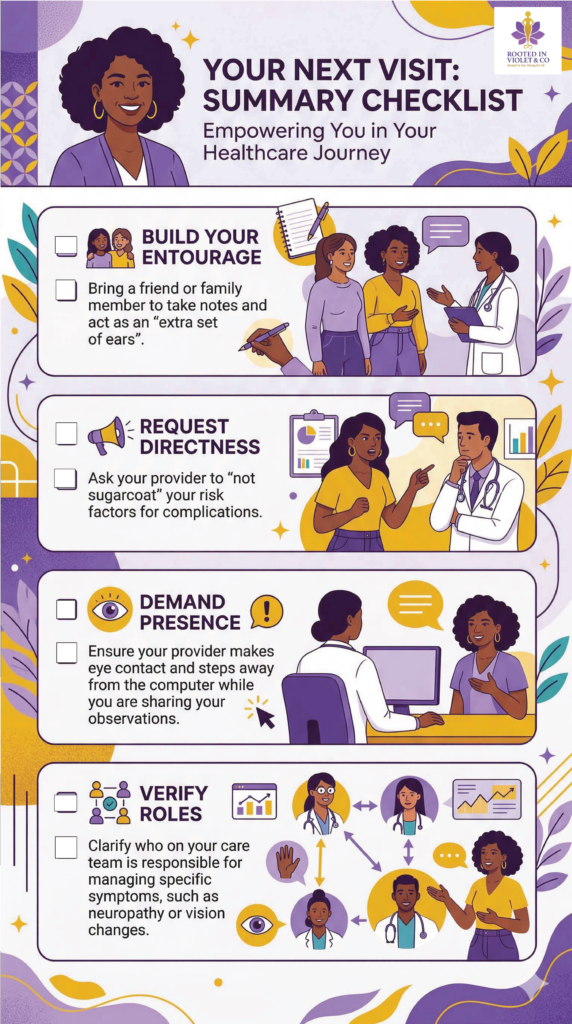
[ ] Build Your Entourage: Bring a friend or family member to take notes and act as an “extra set of ears”.
[ ] Request Directness: Ask your provider to “not sugarcoat” your risk factors for complications.
[ ] Demand Presence: Ensure your provider makes eye contact and steps away from the computer while you are sharing your observations.
[ ] Verify Roles: Clarify who on your care team is responsible for managing specific symptoms, such as neuropathy or vision changes.
Your lived experience is valid clinical information. By turning your daily data into an advocacy tool, you are not just managing a condition—you are protecting your legacy.
References (APA Style)
- American Diabetes Association. (2024). Standards of Care in Diabetes—2024. Diabetes Care.
- Centers for Disease Control and Prevention. (2023). National Diabetes Statistics Report.
- Chinn, J. J., Enard, K., & Franklin, W. (2021). Racial Disparities in Diabetes Care: A Review of the Current State and Future Directions. Journal of Clinical Medicine.