
Medical Gaslighting: Trusting Your Voice in a System That Doesn’t Always Listen
Key Takeaways
- Medical gaslighting is a harmful experience for Black women, as it makes them doubt their own health issues.
- Recognizing the signs of gaslighting, such as dismissing symptoms or labeling patients as ‘difficult’, is crucial for better care.
- The impact of medical gaslighting leads to delayed diagnoses, worse health gaps, and increased emotional stress in Black women.
- Using the ROOT Framework™ can empower women to advocate for their health, including tracking symptoms and being clear about their needs.
- Everyone deserves respectful healthcare that acknowledges their knowledge of their own body and symptoms.

Medical gaslighting toward Black women is a real and harmful experience—but it is different from a doctor who is simply honest about not having all the answers yet.
Naming this difference is important because every woman deserves care that is humble, honest, and respectful of what she knows about her own body. At Rooted in Violet & Co., our mission is to empower you to bridge that gap through education and advocacy.
“Is It in My Head, or Are They Not Listening?”
If you have ever left a doctor’s office feeling like you were overreacting, you are not alone. Many Black women report being told their pain is “normal” or their stress is the only cause of their symptoms, only to find out later that a serious health issue was ignored.
Medical gaslighting happens when a healthcare provider uses their authority to make you doubt your own feelings or symptoms. When racism and sexism are added to this, it creates anti-Black medical gaslighting, a specific way Black women are often dismissed in healthcare.
Spotting the Signs
It is helpful to know what gaslighting looks like compared to a “good” but uncertain provider:
| Medical Gaslighting Looks Like… | A Good Provider Looks Like… |
| Brushing off symptoms as “just stress” without an exam. | Being honest about uncertainty while making a plan. |
| Suggesting you are being “dramatic” about pain. | Validating that your pain is real, even if labs look normal. |
| Ignoring clear patterns you have tracked over time. | Staying curious and asking follow-up questions. |
| Labeling you as “difficult” for asking questions. | Inviting you to be a partner in your care. |
The Impact of Medical Gaslighting
The research shows that this isn’t just about “hurt feelings”—it is a major safety issue. Gaslighting can lead to:
- Delayed Diagnoses: Serious conditions such as heart disease or preeclampsia may be diagnosed too late.
- Worse Health Gaps: For Black women, gaslighting adds a layer of risk to already high rates of maternal mortality and chronic illness.
- Emotional Stress: A study on chronic pelvic pain found that fewer than 50% of women felt their doctors were supportive, 25% felt belittled, and 20% felt they were not believed at all.
Using the ROOT Framework™ to Protect Your Truth
At Rooted in Violet, we believe you are the architect of your own health. To help you move from silence to strategy, use our ROOT Framework, an evidence-informed blueprint for self-advocacy.
- R – Reveal What’s Going On: Don’t rely on memory alone. Track your symptoms, triggers, and emotions in a journal or digital log. This turns your feelings into “data” that is harder for a provider to dismiss.
- O – Offer Your Observations: Use specific, fact-based language. Instead of saying “I feel bad,” try: “I have noticed this sharp pain every morning for two weeks. It is not normal for my body.”
- O – Outline What You Need: Be clear about your goals. Ask for specific tests, referrals to culturally competent doctors, or a second opinion. You can say, “I’m not comfortable leaving without a plan for what happens next.”
- T – Take Note & Follow-Up: Document every conversation and diagnosis. Advocacy is a practice that builds accountability. If you don’t feel heard, you have the right to set boundaries or find a new provider.
Your body is not a debate topic, and your symptoms are not a negotiation. You deserve a partner in health who respects your humanity.
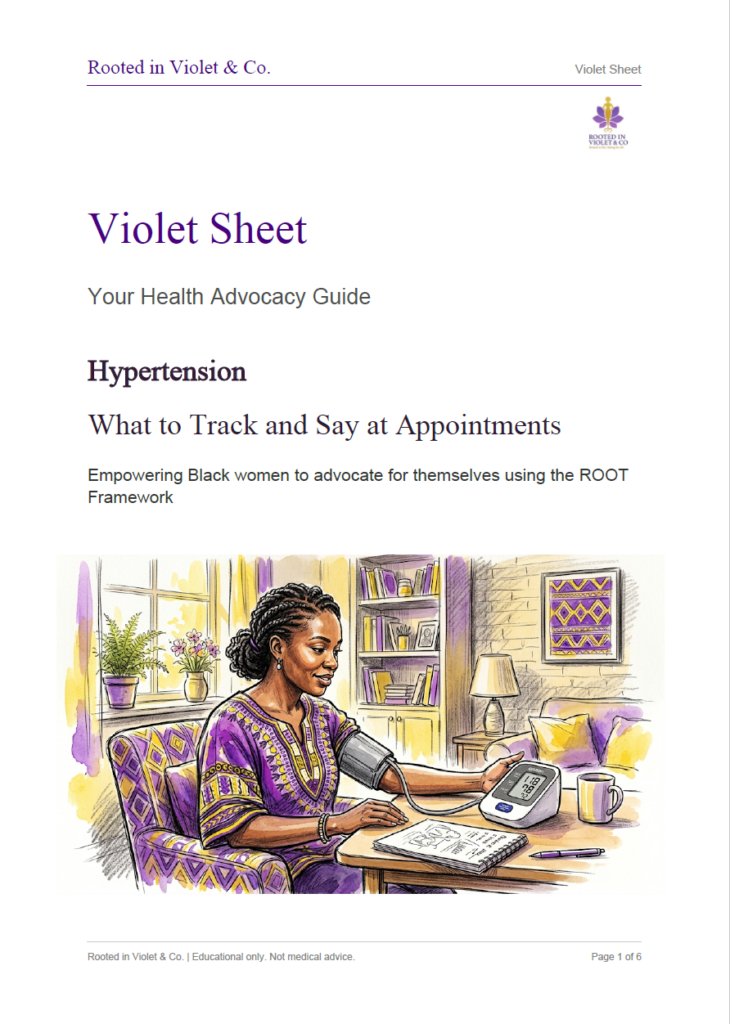
Hypertension: What to Track and Say at Appointments Violet Sheet
🌿 Ready to take the next step? Get our Hypertension: What to Track and Say at Appointments Violet Sheet today to start tracking your blood pressure and preparing your questions for your next visit.
References
- Frontiers in Health Services. (2025). Medical gaslighting: Navigating patient–clinician mistrust in healthcare.
- International Journal of Innovative Science and Research Technology. (2025). Psychological effect of medical gaslighting on female patients.
- Journal of General Internal Medicine. (2024). Narrative review of medical gaslighting and introduction to medical invalidation.
- Qualitative Health Research. (2025). This year is not about carrying the heaviest burden: A qualitative study on Black women’s postpartum experiences.