
Understanding Weathering: Why “Staying Strong” Isn’t Always Enough
Key Takeaways
- Weathering, a concept introduced by Dr. Arline Geronimus, refers to the accelerated aging caused by systemic and interpersonal racism.
- The Superwoman Schema exemplifies how the pressure to stay strong affects the health of African American women, leading to chronic stress.
- Research shows that Black women face an earlier onset of conditions like insulin resistance and hypertension, creating an Intervention Gap in healthcare.
- The ROOT Framework empowers individuals to advocate for their health by revealing symptoms, offering context, outlining needs, and following up.
- Practicing self-advocacy helps transform from a passive patient to an active partner in health; your voice is your strongest medicine.
When we talk about health in our community, we often hear about “lifestyle choices”—what we eat, how much we move, and how well we sleep. But for many African American women, there is a hidden factor at play that isn’t found on a dinner plate or a treadmill. It’s called weathering.
Pioneered by Dr. Arline Geronimus, weathering is the idea that the cumulative, lifelong stress of navigating a society with systemic and interpersonal racism actually causes our bodies to age faster on the inside. It’s like a structure enduring a constant storm; eventually, even the strongest foundation begins to wear down.
The Biological Toll of the “Superwoman Schema”
Many of us take pride in being the “backbone” of our families and communities. While this strength is a superpower, the cultural obligation to always present as strong and suppress our emotions—known as the Superwoman Schema—comes at a physical price.
Research shows that this constant “high-effort coping” keeps our bodies in a permanent “fight-or-flight” state. This isn’t just a feeling; it’s a molecular transformation:
- Allostatic Load: This is the “wear and tear” on the body that accumulates from repeated or chronic stress.
- Inflammation Cascade: Constant stress triggers proteins that circulate in the blood, leading to plaque buildup in your arteries and insulin resistance.
- Cellular Aging: Weathering can even shorten our telomeres—the protective caps on our chromosomes. When these caps get too short, our cells age prematurely.
Breaking the “Standard” Timeline
The medical community often uses guidelines based on the “average” patient, but these averages rarely account for the accelerated biological aging Black women face. This creates an Intervention Gap—a dangerous delay in treatment because a doctor thinks you are “too young” for a condition.
| Health Marker | Onset Gap (How much earlier it hits Black women) |
| Insulin Resistance | 11.3 Years Earlier |
| Isolated Systolic Hypertension | 7.7 Years Earlier |
| Hypertension (General) | 5.4 Years Earlier |
| Heart Failure | 20-Fold Risk before age 50 |
Reclaiming Your Agency with the ROOT Framework
At Rooted in Violet & Co., we believe that understanding weathering is the first step toward self-advocacy. You are the architect of your own health, and your lived experience is just as important as a clinical test.
Use the ROOT Framework to bridge the gap between your body’s reality and the medical system’s expectations:
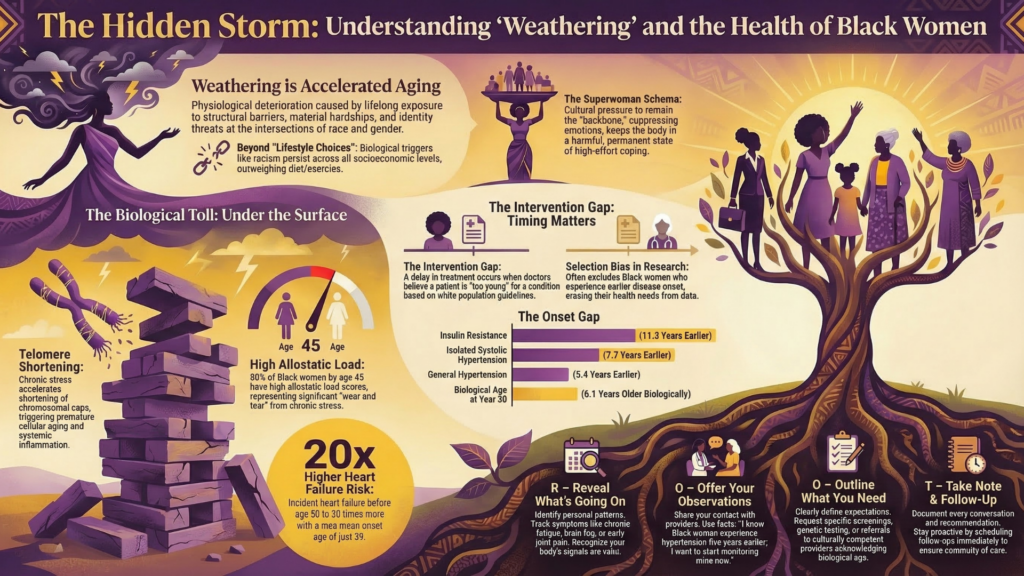
R – Reveal What’s Going On
Identify the patterns in your life. Are you experiencing “weathering” symptoms like chronic fatigue, early-onset joint pain, or persistent “brain fog”?
- Action: Track your symptoms, emotions, and stress levels in a journal.
- Goal: Recognize that your body’s signals are valid and deserve investigation, not dismissal.
O – Offer Your Observations
Shift your awareness into communication. When you go to the doctor, don’t just list symptoms; share your context.
- Action: Use specific, fact-based language. For example: “I know that statistically, Black women experience hypertension five years earlier than average. I want to start monitoring mine now.”
O – Outline What You Need
Define your expectations clearly. You have the right to request screenings, referrals, or even a second opinion from a culturally competent provider.
- Action: Collaborate with your team to build a personalized care plan that acknowledges your biological age, not just your birth year.
T – Take Note & Follow-Up
Advocacy is a practice, not a one-time event.
- Action: Document every conversation and medical recommendation. Schedule your follow-ups immediately so you stay proactive rather than reactive.
Your Voice is Medicine
For too long, our pain and intuition have been minimized. By practicing the ROOT Framework, you transform from a patient navigating a system to a partner designing your health outcomes.
“Reveal. Offer. Outline. Take Note. — Because your voice is the strongest medicine you have.” Get your Weathering & Wellness Checklist to help you get started.
References
- Geronimus, A. T. (2023). Weathering: The Extraordinary Stress of Ordinary Life in an Unjust Society.
- Centers for Disease Control and Prevention (CDC). (2024). Racial Disparities in Chronic Disease.
- National Institutes of Health (NIH). (2023). The Impact of Allostatic Load on Women’s Health.