
Key Takeaways
- The New Age Standard: Health organizations now recommend colorectal cancer screening starting at age 45, especially for Black women due to higher early-onset rates.
- Screening Options: You have choices, including at-home FIT tests, stool DNA tests, and colonoscopies, offering flexibility in approach.
- The Insurance Gap: Access to health insurance significantly impacts screening rates and survival outcomes for Black adults.
- The ROOT Framework™: This tool empowers you to track symptoms, communicate effectively, and advocate for timely screenings.
- Policy Power: Systemic changes in healthcare policies are essential to close the survival gap and improve access to screening for Black women.
The 45 Factor: A Shift in Protection

For years, we were told that 50 was the magic number for colon health. But the rules have changed, and understanding why colorectal cancer screening matters for Black women between the ages of 25 and 65 is vital. In fact, it can be lifesaving. Major health organizations now recommend that everyone at average risk start colorectal cancer (CRC) screening at age 45 instead of 50. Why the change?
Research shows that African Americans are experiencing higher rates of early-onset colorectal cancer and are often diagnosed at later stages when the disease is harder to treat. This makes colorectal cancer screening especially important for early detection and prevention.
If you are an African American woman with no major family history of colon cancer, 45 is your new start date for colorectal cancer screening.
What does screening look like? It doesn’t always mean a colonoscopy immediately. Approved methods include:
- FIT (Fecal Immunochemical Test): A simple yearly FIT test done at home.
- Stool DNA tests: Done every 1–3 years.
- Colonoscopy: The “gold standard” exam done every 10 years as part of important colorectal cancer screening efforts.
Understanding the Disparities in Colorectal Cancer
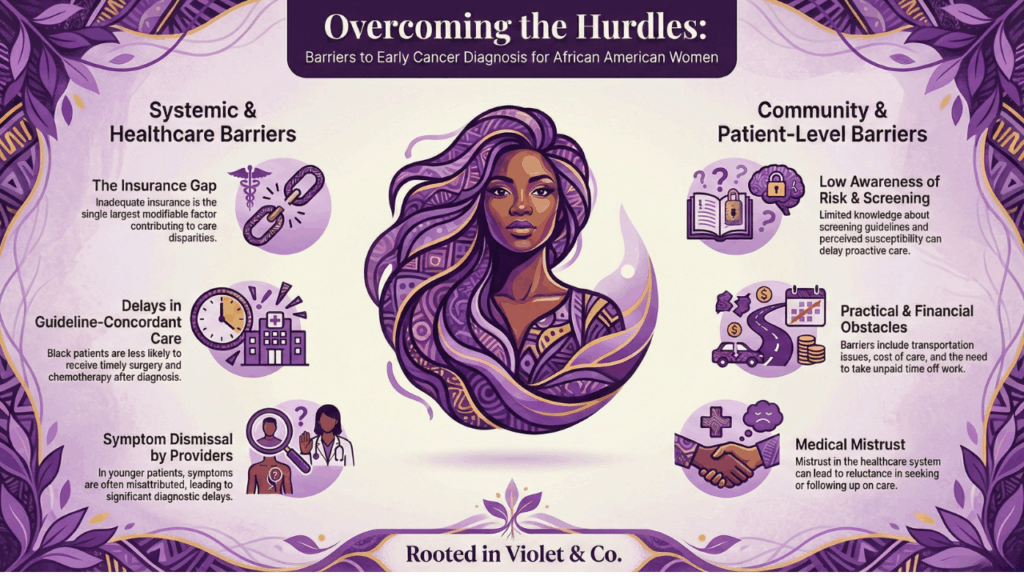
We have to be honest about the numbers so we can change them. Black adults face a heavier burden when it comes to this disease. Therefore, increasing access to colorectal cancer screening helps reduce disparities.
- African American women are more likely to be diagnosed at an advanced stage compared to other groups due to gaps in access to colorectal cancer screening.
- Survival outcomes are lower, largely due to treatment delays.
But here is the most important truth: This isn’t just about biology; it’s about access.
Evidence shows that health insurance status is the single biggest factor driving these disparities. Being uninsured or underinsured blocks access to early screening and timely treatment. In fact, studies show that if Black and White communities had equal access to insurance and screening, most of the difference in cancer rates would disappear, especially when colorectal cancer screening is prioritized.

Advocating for Your Gut with the ROOT Framework
At Rooted in Violet & Co., we believe self-advocacy is not a skill you’re born with — it’s a practice you grow into. Advocacy is a form of healing. Every woman is the architect of her health. Physicians are partners in your health journey, not gatekeepers. You can use the ROOT Framework™—our signature, evidence-informed method—to navigate these new guidelines and demand the care you deserve.
R = Reveal What’s Going On. This step is about self-awareness and pattern recognition.
- Track your habits: Track symptoms, emotions, or health changes in journals or digital logs. Identify triggers, timelines, and patterns that may indicate underlying issues.
- Know your history: Did a parent or sibling have polyps or cancer? If you have a first-degree relative who had colon cancer, you may need to start screening 10 years before the age at which they were diagnosed.
- Empowerment Goal: Recognize that your body’s signals are valid and deserve investigation, not dismissal.
O = Offer Your Observations. This phase shifts awareness into communication. When you get to the doctor, don’t downplay your symptoms.
- Speak clearly: Clearly articulate what you’ve noticed during medical appointments. Use specific, fact-based language to describe changes and concerns.
- Address the bias: We know that symptoms in young Black women are sometimes dismissed as “just stress” or hemorrhoids. By offering specific, fact-based details, you make it harder for a provider to overlook your concerns.
- Empowerment Goal: Become an active contributor in your healthcare conversation, not a passive participant.
O = Outline What You Need. Here, women define their expectations and needs. Be direct about your expectations.
- Express your needs: Express preferences about diagnostic tests, treatment options, and follow-up care.
- The Script: “I know the national guidelines now recommend screening start at age 45. I am 45 (or I have symptoms), and I would like to discuss scheduling a colonoscopy or ordering a FIT test today.”
- Request support: Request referrals, second opinions, or culturally competent providers.
- Empowerment Goal: Reclaim control over your care by identifying what success and support look like for you.
T = Take Note & Follow-Up This final phase transforms advocacy into accountability. Maintaining good records and following up on colorectal cancer screening results protects your health.
Empowerment Goal: Turn advocacy into an ongoing practice that protects your health and builds trust with your providers.
Circle back: Schedule follow-ups and set reminders for screenings or labs. If you need a follow-up colonoscopy because of an abnormal home stool test, ensure your insurance doesn’t wrongly charge you for a “diagnostic” procedure when it is part of the screening continuum.
Write it down: Document every conversation, diagnosis, and medical recommendation. If a doctor denies your request for screening, ask them to document why they are denying it in your medical record.
The Big Picture: Fighting for Policy Change
While we do our part in the exam room, systemic changes are also necessary. Evidence shows that expanding Medicaid and eliminating cost-sharing for all screening (including follow-up care) are critical steps to closing the survival gap for Black women. Ultimately, improved access to colorectal cancer screening is key to saving more lives and reducing disparities in care.
Your Next Step
Reveal. Offer. Outline. Take Note. — Because your voice is the strongest medicine you have. Your voice is the strongest medicine you have. Don’t wait for symptoms to shout before you listen to a whisper. Early attention to colorectal cancer screening is always best.
🌿 Call to Action: Check your calendar. If you are 45 or older, or if you have a family history of colon cancer, open your Violet Sheet today, write down your family history, and call your provider to schedule your screening. Regular colorectal cancer screening is one of the best ways to ensure early detection and better outcomes.