
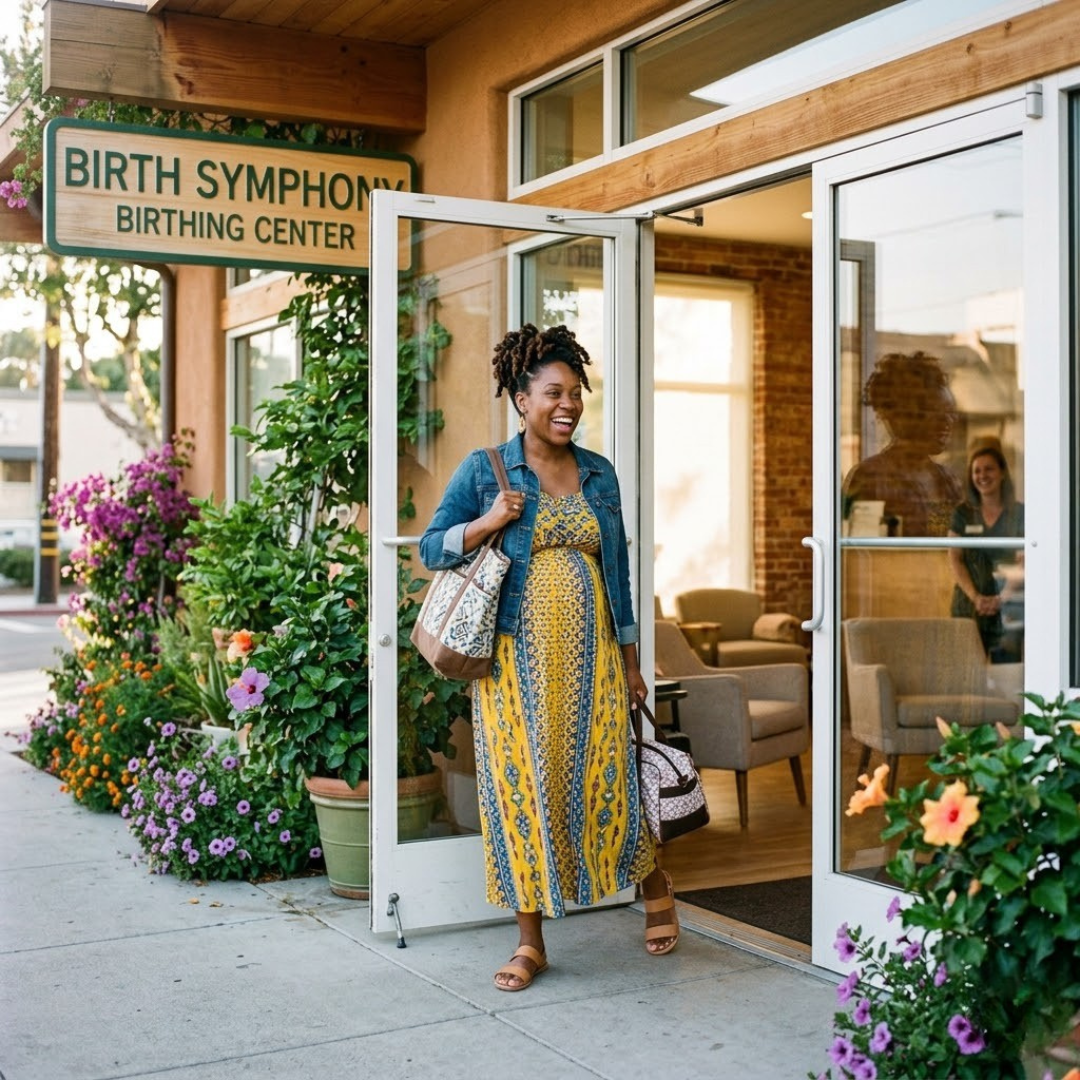
Midwives, birth centers, and home birth—and how to decide what is safest and most aligned for you.
Black maternal health spaces have been clear about one thing in recent years: the crisis is not new, and Black communities are building their own solutions.
A growing part of that solution is the resurgence of Black midwifery and Black‑led birth centers, where care is designed around relationship, respect, and cultural grounding rather than throughput and control.
On Monday, the focus was on self‑advocacy in any maternity setting. Today, the lens zooms in on a question more Black women are quietly asking themselves: If the hospital system has never really felt safe for me, what other options do I have—and are they actually safe?
A two‑birth story that says everything.
Imagine this:
The first birth takes place in a busy hospital. The monitors beep, staff rotate in and out, and “routine” procedures are performed with minimal explanation. The birthing person, a Black woman in her 20s, has her concerns about pain brushed off and feels pressured into interventions she never fully understood. Months later, the lingering feeling is not just physical recovery—it is the sense that things were done to her, not with her.
The second birth looks different. This time, she has a small midwifery team she has seen throughout pregnancy, longer prenatal visits where her questions are welcomed, and a birth plan that is actually discussed. Labor unfolds in a freestanding birth center or at home with a qualified midwife, with clear plans in place if transfer to a hospital becomes necessary. This shift—from being managed inside a system to being centered by a team—is part of why more Black women are exploring community birth. It is not about chasing a trend; it is about seeking safety in a system that has repeatedly failed to protect them.
Why hospital birth often feels unsafe for Black women
Mainstream maternity care in the United States was built inside institutions that have long excluded or targeted Black midwives, Black birthing people, and Black families.
Black Maternal Health Week campaigns continue to emphasize that Black women are more likely to experience disrespectful care, poor communication, and delayed responses to serious symptoms in hospitals. National and state reports repeatedly show that Black women are more likely to die from pregnancy‑related causes and more likely to experience severe complications than White women, even when income and education are similar. Researchers and advocates have pointed out that hospitals serving more Black and low‑income patients often have fewer resources and worse outcomes, which further erodes trust. So when Black women say they are uneasy in hospital spaces—worried their concerns will be dismissed or their bodies will be treated as problems to control rather than people to care for—that unease is not paranoia. It is grounded in lived experience and in data.
What community birth actually is (and what it is not)
“Community birth” is a broad term that usually refers to midwifery‑led care outside of a standard hospital labor and delivery unit.
The main models include:
- Freestanding birth centers: Home‑like facilities (often midwife‑led) that serve low‑risk pregnancies and have protocols for transfer to nearby hospitals if needed.
- Home birth with a qualified midwife: Planned births at home for carefully screened pregnant people, attended by trained midwives with emergency equipment and transfer plans.
- Group midwifery care models: Some programs use group visits and Black midwives to provide relationship‑centered care specifically for Black birthing people.
Community birth is not unregulated or “do‑it‑yourself” care. Research on midwifery‑led birth centers shows that, for low‑risk pregnancies, these settings can reduce preterm birth, low‑birth‑weight babies, cesarean sections, and neonatal intensive care admissions while using person‑centered midwifery care. Many Black‑led birth centers are explicitly focused on neighborhoods where Black women face the highest risks and the least access to respectful, consistent care.
There are limits. Community birth models are not appropriate for every pregnancy, and safe programs rely on strict risk screening and tight collaboration with hospitals. The point is not that community birth is “better” for everyone; the point is that it offers Black women more options to seek care that aligns with their health needs and sense of safety. The history—and resurgence—of Black midwifery. For generations, Black midwives were the backbone of maternity care in many Southern communities, providing skilled, culturally grounded care long before hospitals opened their doors to Black patients. Their knowledge was systematically undermined by policies that favored white male physicians and framed community midwives as dangerous or untrained, despite their deep experience.
Advocates and historians have traced how licensing laws, public health campaigns, and hospital expansion pushed many Black midwives out of practice, contributing to today’s shortage of Black midwives and Black‑led maternity spaces. The result is a mismatch between who is most affected by the maternal health crisis and who holds power within the system. The recent resurgence of Black midwifery—through collectives, training programs, and community organizations—is not nostalgic. It is a modern movement to rebuild a workforce and care model that centers Black women’s lives, stories, and safety. Investing in Black‑led birth centers and midwifery trainings is increasingly framed as a direct investment in the health, dignity, and survival of Black mamas and babies.
What safety means—for you
Safety is not just equipment and protocols; it is also whether a birthing person feels fully human in the room.
Questions to reflect on:
- What images or stories come to mind when thinking about hospital birth, and where did those stories come from?
- In stressful moments, which settings feel more likely to believe you quickly—your local hospital, a midwifery‑led birth center, or a Black‑led practice?
- How important are things like freedom to move, use upright positions, include cultural or spiritual practices, or control who enters your birth space?
These reflections do not produce a “correct” answer; they surface values. For some Black women, the combination of hospital equipment and strong community support feels best. For others, the relational model and environment of a birth center or home birth align more closely with safety and dignity—as long as there is a credible emergency transfer plan.
Questions to ask birth centers, midwives, and hospitals
Whether a reader leans toward hospital birth, a birth center, or home birth, self‑advocacy means asking detailed questions and watching how the answers feel in the body. Some questions to consider:
For midwives and birth centers
- What are your credentials and training? How long have you been practicing?
- How do you decide who is a good candidate for birth here and who should deliver in a hospital?
- What specific emergencies are you prepared to handle on-site?
- What is your transfer plan if labor stops progressing, if the baby shows distress, or if my health changes?
- Which hospital(s) do you work with?
- How does your team specifically support Black families and address racism and bias in care?
Person‑centered midwifery models emphasize longer visits, shared decision‑making, and broader attention to social stressors, which can be especially important in communities of color.
The answers to these questions should make that philosophy visible.
For hospitals and OB/GYN practices.
- How do you feel about working with midwives and doulas as part of my team?
- Under what circumstances do you recommend induction or a cesarean, and how will we discuss those decisions?
- Can I move, change positions, use water, or eat and drink during labor if everything is normal?
- How will you respond if I say no or need more time to decide on a procedure?
- What steps do you take to address racial bias and ensure respectful care for Black patients?
A provider’s reaction to these questions is often as important as the content of the answer. Eye‑rolling, defensiveness, or dismissal are information.
Handling fear, family pushback, and myths
Choosing community birth can trigger fear in loved ones who associate hospitals with modern safety and birth centers or home birth with risk. Many older relatives remember eras when Black families were denied hospital care or forced into segregated wards; for them, hospital access feels like progress to protect, not something to question.
It may help to:
- Acknowledge their fear: “I know you’re scared because you love me and want me and the baby to be okay.”
- Share the facts: Explain that midwifery‑led birth centers are regulated, follow strict screening protocols, and have clear transfer plans, and that research shows they can reduce many adverse outcomes for low‑risk pregnancies.
- Introduce the team: Invite concerned relatives to meet the midwife team or tour the birth center so they can see the environment and ask their own questions.
Myths cut both ways. There are myths that community birth is always dangerous and myths that hospitals are always unsafe. The reality is more nuanced: risk lives in how systems respond to complications, how quickly help is available, and how well a setting’s strengths match a particular pregnancy.
When hospital birth is medically necessary
Some pregnancies are not appropriate for community birth, no matter how strong the desire to avoid the hospital. Certain heart conditions, severe hypertension, placenta complications, multiples, or previous high‑risk births may require hospital‑based care for safety.
For Black women in these situations, the question becomes: How do I bring community values and advocacy into a hospital space that still carries risk?
Practical moves include:
- Hiring a doula who is comfortable navigating hospital systems and understands racial dynamics in care.
- Creating a flexible birth plan that focuses on what matters most (clear communication, consent, mobility, cultural practices) rather than rigid timelines.
- Choosing a hospital or practice with better track records for Black patients where options exist, including those partnering with midwifery programs and community groups.
- Clarifying priorities early:
“If things become emergent, my priority is surviving, protecting my baby, and maintaining as much bodily autonomy as safety allows. Can we talk about how we’d navigate that together?”
High‑risk does not have to mean voiceless. It does, however, require a team willing to treat Black patients as partners rather than liabilities.
Community birth as collective self‑defense
Framing community birth as self‑defense is not metaphorical. When Black midwives, birth centers, and community organizations organize around Black Maternal Health Week themes—healing legacies, collective action, and advocacy—they are building infrastructure to catch Black women who might otherwise fall through the cracks. Community‑led birth centers like those highlighted in recent reports are designed to prove that maternal health disparities are a function of delivery system design, not demographic destiny.
Their model is simple but radical: longer visits, more listening, midwifery‑led care, and deep integration with local communities.
Black women choosing these settings are not rejecting medicine; they are rejecting invisibility. They are saying: “I am safer when I am seen.” That is self‑advocacy at both the personal and collective levels.
Closing reflection and next steps
Choosing where to give birth is one of the most intimate decisions a person can make. For Black women, that decision is layered with history, data, and lived experience that cannot be ignored.
A few questions to leave with:
- If nothing about the health system changed, what would make you feel most protected during birth—environment, people, or both?
- Who do you want in the room with you, not just as emotional support but as an advocate?
- What information would you need to feel fully confident in whichever setting you choose?
Reference
- Anyiam, S., Woo, J., & Spencer, B. (2024). Listening to Black women’s perspectives of birth centers and midwifery care: Advocacy, protection, and empowerment. Journal of Midwifery & Women’s Health, 69(5), 653–662. https://doi.org/10.1111/jmwh.13635
- The Commonwealth Fund. (2024, June 6). A community-led approach to transforming maternity care. https://www.commonwealthfund.org/publications/2024/jun/community-led-approach-transforming-maternity-care
- The Commonwealth Fund. (2024, September 12). How community-led maternal health models can thrive with federal funding. https://www.commonwealthfund.org/blog/2024/how-community-led-maternal-health-models-can-thrive-federal-funding
- TIME. (2024, February 28). The history that explains today’s shortage of Black midwives. https://time.com/6727306/black-midwife-shortage-history/
- Center for Children and Families at Georgetown University McCourt School of Public Policy. (2025, April 16). Black Maternal Health Week 2025: Healing legacies: Strengthening Black maternal health through collective action and advocacy. https://ccf.georgetown.edu/2025/04/17/black-maternal-health-week-2025-healing-legacies-strengthening-black-maternal-health-through-collective-action-and-advocacy/