
Key Takeaways
- Black women’s mental health often goes unaddressed due to stigma and systemic racism in healthcare settings.
- The ROOT Framework™ empowers Black women to advocate for their mental health during medical appointments.
- Reveal your feelings openly with your doctor; offer real examples of your mental health concerns.
- Outline specific needs, like screening for anxiety, and take note of the provider’s response for accountability.
- Using resources like Violet Sheets™ can help prepare for discussions about mental health effectively.
When Your Mind Is Heavy but You Still Show Up: A Black Woman’s Guide to Naming Mental Health at Any Appointment
When you walk into the doctor’s office, you might be there for a specific reason—high blood pressure, heavy periods, joint pain, or just your yearly checkup. But your mind is often heavy, too. You’re tired, snappy, or maybe you were crying in the car and had to “pull it together” in the parking lot.
Still, when the doctor asks, “How are you?” you say, “I’m fine.” You are not alone. Black women’s mental health is deeply affected by the fact that, for too long, Black women’s pain, intuition, and voices have been ignored or minimized in medical spaces. We are often trained to be the “strong one”—holding up the family, working twice as hard, and praying through the pain.
But that strength can come at a high cost. While nearly 20% of Black adults experienced a mental health condition in the past year, only about one in three who need care actually receive it.
This gap isn’t because we are “stronger” or feel less; it is because of stigma, systemic racism, and a healthcare system that often ignores what we say. At Rooted in Violet & Co., we believe your voice is the strongest medicine you have. This guide will help you use the ROOT Framework—our signature blueprint for self-advocacy—to make sure your mental health is seen and supported at every visit.
Why Your Mental Health Gets Missed
In a 15-minute doctor’s visit, the focus is usually on your physical numbers—your weight, your blood pressure, or your lab results. If you are managing a chronic illness or a cancer follow-up, your mood often gets skipped entirely. Additionally, many of us carry the “Strong Black Woman” script. We are taught that admitting we are struggling is a sign of weakness. But chronic stress, discrimination, and the weight of caregiving show up in the body. Mental health struggles aren’t personality flaws; they are signs that your body and mind need care.
When mental health is ignored, it affects everything else. For example, untreated depression and anxiety can worsen heart health and make it harder for your body to heal. By using the ROOT Framework, you can move from silence to strategy.
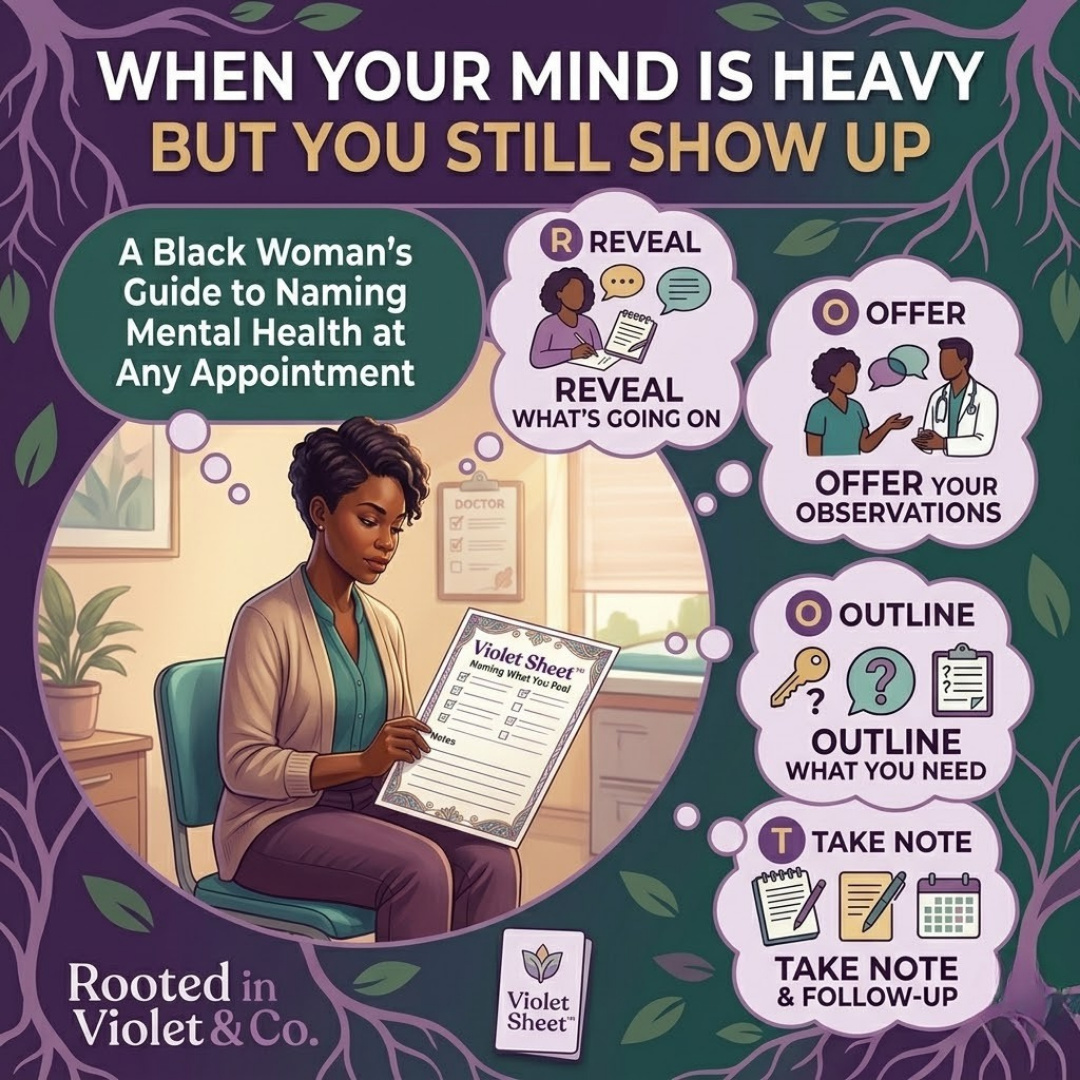
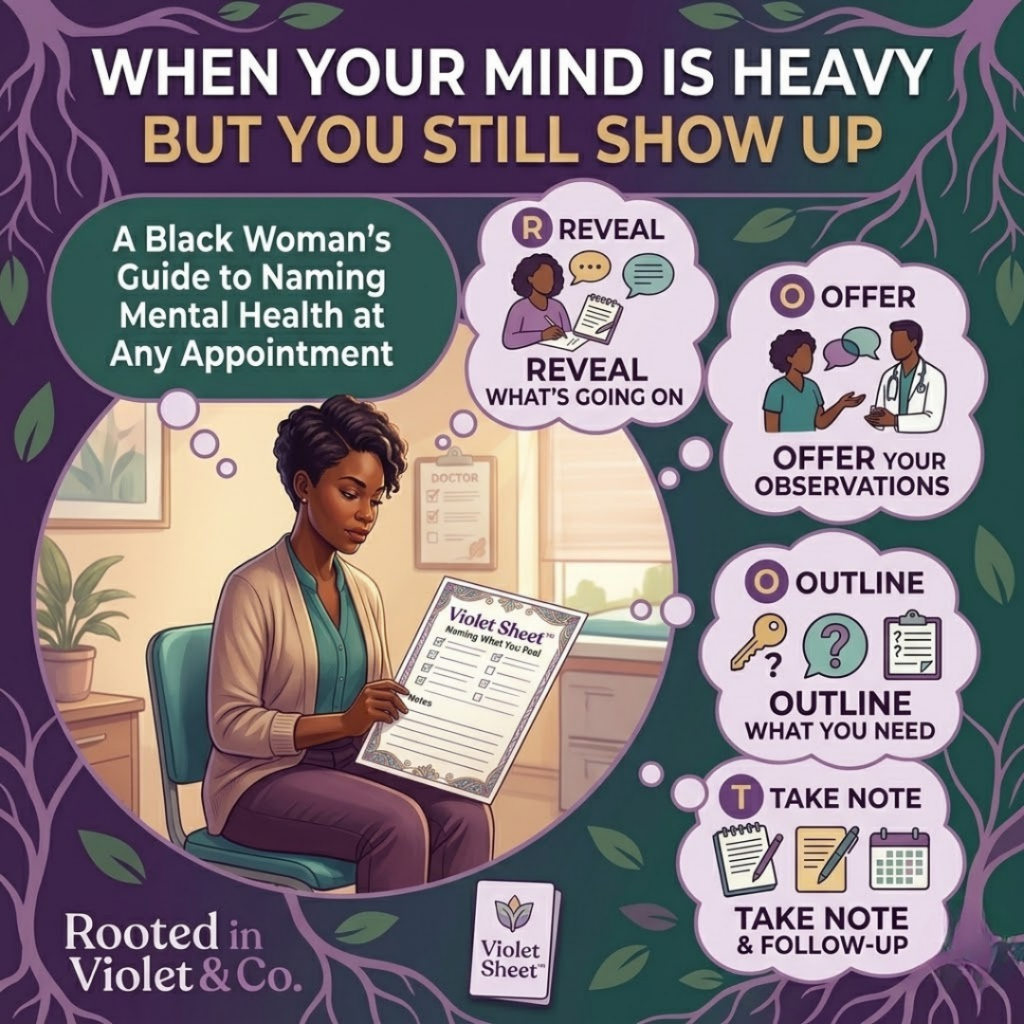
R – Reveal: Name What’s Really Going On
The first step, Reveal, is about self-awareness and honesty—first with yourself, and then with your provider. You do not need medical terms or a formal diagnosis to start this conversation. You just need to speak your truth.
Before your appointment, take a moment to track your patterns. Have you noticed:
- Crying more than usual or feeling “numb”?
- Snapping at your family or feeling irritated over small things?
- Trouble sleeping or wanting to sleep all the time?
- Brain fog, trouble focusing, or forgetting things?
The Empowerment Goal: Recognize that your body’s signals are valid and deserve investigation, not dismissal.
Try saying this: > “Over the last month, my mood has been very low, and I feel overwhelmed almost every day. I’ve noticed I’m not sleeping well, and I want to talk about why.”
O – Offer: Bring It Into Any Appointment
The Offer phase is where you shift from awareness to communication. You are “offering” your observations as evidence for your care plan.
Physicians should be your partners, not your gatekeepers. You bring the lived experience of your own body, and they bring the clinical expertise. True wellness happens when both voices are valued equally.
Try saying this:
- At the OB-GYN: “I’m here for my annual exam, but since my last pregnancy, I’ve been feeling anxious and not like myself. I’d like to include that in our talk today.”
- At a Chronic Care Visit: “My physical pain has been worse lately, and my mood is very low. I think they might be related, and I’d like to address both.”
The Empowerment Goal: Become an active contributor in your healthcare conversation, not a passive participant.
O – Outline: Ask for What You Need Clearly
In the Outline step, you define your expectations. This is where you ask for specific actions, such as screenings, referrals, or treatment options. You are not asking for a favor; you are asking for standard, equitable care.
Ask these questions to outline your needs:
- “Can you screen me for depression or anxiety today?”
- “What options do I have for support besides just ‘waiting and see’?”
- “Can you refer me to a therapist who understands the specific stresses Black women face?”
- “How can we follow up on this? Can we schedule a separate visit just for my mental health?”
The Empowerment Goal: Reclaim control over your care by identifying what success and support look like for you.
T – Take Note: Watch the Response and Follow-Up
The final step, Take Note, transforms your advocacy into accountability. It’s about documenting what happened and deciding on next steps.
Pay attention to how your provider responds. A supportive partner will listen and offer options. A dismissive provider might say, “You’re just stressed,” or “Let’s focus on your blood pressure instead.”
If you feel brushed off, you can say: “I understand our time is short, but this is affecting my daily life. I need us to document my concerns and create a plan to address them.”
The Empowerment Goal: Turn advocacy into an ongoing practice that protects your health and builds trust with your providers.
How to Use the “Naming What You Feel” Violet Sheet
At Rooted in Violet & Co., we created Violet Sheets—printable advocacy guides—to make this process easier. These sheets walk you through each ROOT step for specific needs.
To prepare for your next visit, download our Naming What You Feel Violet Sheet:
- Check the box or circle the words on the sheet that describe your mood and energy.
- Write one or two short examples of how you feel (e.g., “Crying before work”).
- Write down two questions you want to ask using the Outline step.
- Bring it with you. When your mind goes blank in the exam room, look at your sheet and say: “I’ve written down what I’m noticing, and I’d like us to go through it.”
You Are the Architect of Your Health
Speaking up isn’t confrontation; it is collaboration. Advocacy is a form of healing because it restores your dignity in systems that often try to silence you. You deserve to be seen, heard, and cared for—not just for your “numbers,” but for your whole self.
🌿 Next Step: Complete your Daily Wellness & Self-Advocacy Tracker today. This tool is free! Fill it out tonight, download it, and commit to sharing one “Reveal” at your next appointment.
Daily Wellness & Self-Advocacy Tracker
A private space to root your daily health journey in awareness, compassion, and data-informed strategy.
Rising for All
Save Your Daily Entry
Generate a clean document of your current wellness data to save to your device or print.
References
- American Psychological Association. (2023). Black/African American mental health statistics and disparities.
- Centers for Disease Control and Prevention (CDC). (2024). Mental health surveillance and statistics.
- JAMA Network. (2022). Racial disparities in mental health treatment and access among women.
- National Institutes of Health (NIH). (2023). The impact of chronic stress on physical health in marginalized communities.