
Unmasking the Superwoman Schema and Reclaiming Our Health
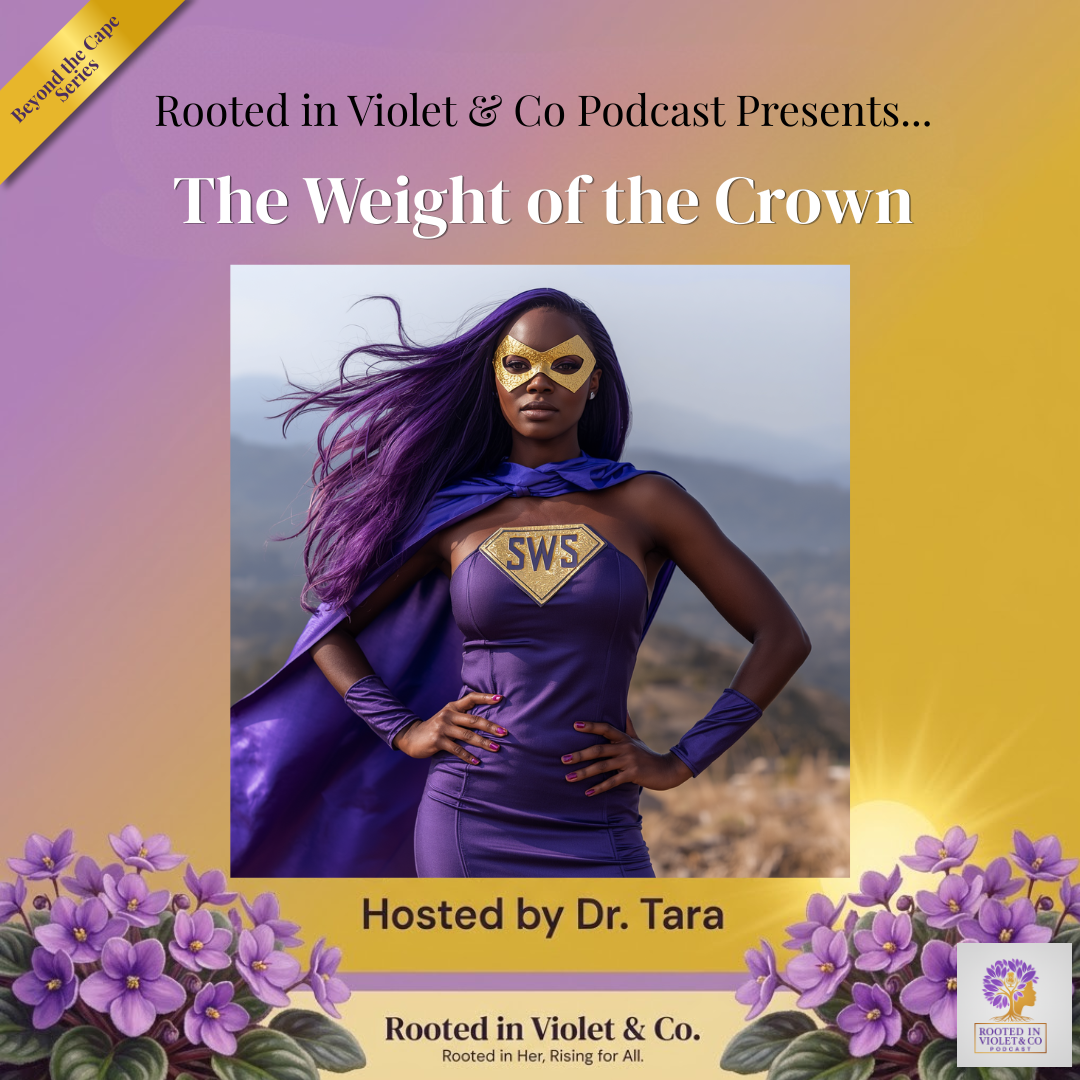
Welcome to the written companion of the Rooted in Violet & Co. Podcast. Whether you’re here to take notes on our latest advocacy strategy or prefer to digest these insights in silence, this transcript is designed to help you move from uncertainty to strategy. Below is the full conversation from Beyond the Cape | Episode 1: The Weight of the Crown.
Welcome to the Rooted in Violet & Co. Podcast. I’m your host, and today we are beginning a journey that many of us have been walking in silence for a very long time. This is the first episode of our new series: Beyond the Cape—Unmasking the Superwoman Schema.
We’ve all heard it: the “Strong Black Woman.” It’s a badge of honor we’re handed before we’re even old enough to understand what it costs to wear it. But what if that strength isn’t just a personality trait? What if it’s a sophisticated survival mechanism forged in history that is now writing a biological receipt our bodies can no longer pay?
At Rooted in Violet, we believe self-advocacy is a practice you grow into. Today, we’re unpacking the historical roots of the “cape,” deconstructing the five dimensions of the Superwoman Schema, and learning how to reclaim our right to be human. Because your voice is the strongest medicine you have.
The Genesis of Strength
To understand why we feel the need to be “super,” we have to look back. The “Strong Black Woman” archetype didn’t appear out of thin air. It emerged as a vital survival tool to counter dehumanizing tropes used to justify exploitation—historical narratives that tried to silence our pain and our agency.
By adopting a posture of superhuman resilience, our ancestors transformed endurance into a cultural ideal. But in modern clinical terms, we call this the Superwoman Schema (SWS).
I want us to get real for a second about what this schema actually feels like when you’re standing in your kitchen at 6:00 AM or sitting in a cold exam room. SWS is made up of five specific dimensions:
- The Obligation to Project Strength: This is the mandate to stay unwavering even when you are crumbling inside. It’s leading the meeting with a smile while you’re privately navigating a health scare.
- Suppressing Emotions: This is the active silencing of feelings like sadness or fear because you’re afraid the world will label you “weak” or “difficult.” You swallow your frustration when a provider dismisses your pain, staying “polite” while your spirit is hurting.
- Resistance to Vulnerability: This creates the “Help-Seeking Paradox.” It’s the belief that asking for help is a failure of character. You have the resources, but you tell yourself you “should” be able to handle it alone.
- The Motivation to Succeed: This is an intense drive to disprove negative stereotypes through sheer perfectionism. You feel you have no room for a “bad day” because you’re carrying the reputation of your entire community.
- The Obligation to Help Others: This is prioritizing everyone else’s well-being over your own rest. You’re the architect of everyone’s health but your own.
The Biological Receipt
When we stay in this “super” mode, it isn’t just “stress”—it is a biological cost.
Let’s talk about our literal survival. I want you to hear these numbers as sisters and friends: According to the CDC, the maternal mortality rate for Black women is 69.9 per 100,000 live births, compared to 26.6 for White women. That is a 2.6-fold difference. This is the “Double-Edged Sword.” Because the world sees us as “superhuman,” they often assume we are “pain-proof.” The system often ignores our whispers because it expects us to be superhuman. But our bodies are telling a different story.
Understanding the Science: Telomeres & Allostatic Load
I don’t want to gloss over the science here. Research shows that high adherence to this Superwoman Schema is linked to telomere shortening.
Picture a shoelace. The plastic tips at the end that keep the lace from fraying are called aglets. In your body, your DNA is the shoelace, and telomeres are those plastic tips. Chronic stress—the “sandpaper” of navigating gendered racism—rubs those tips away until your cells start to “fray” before they are supposed to. That is premature cellular aging.
Then there is allostatic load. Think of your body like a high-performance engine. “Allostasis” is your body’s ability to rev up when stressed and cool down when safe. Allostatic load is the wear and tear that happens when that engine stays in the red zone for too long. Your nervous system and hormones are being pushed past their limits because you’re carrying the weight of the system and the weight of the cape at the same time.
The ROOT Framework in Action
If the system expects us to be superhuman, we have to be strategic. This is why we developed the ROOT Framework™—a signature method to help you move from uncertainty to understanding.
- R – Reveal What’s Going On: Be honest with yourself first. Recognize that your body’s signals—the fatigue, the pain, the anxiety—are valid and deserve investigation, not dismissal.
- O – Offer Your Observations: Move from being a passive participant to an active contributor. Use specific, fact-based language to describe what you’ve noticed about your body.
- O – Outline What You Need: Reclaim control by being clear about what you’re asking for—whether it’s a specific test, a referral, or a second opinion.
- T – Take Note and Follow-Up: Document every conversation and recommendation. This turns advocacy into a consistent practice that protects your health.
The ROOT Reflection
Before we part ways, I want to leave you with a small practice: the ROOT Reflection.
- Reveal: Tonight, ask your body, “What are you actually trying to tell me?” Write down the truth about any pain or exhaustion you’ve been “toughing out.”
- Offer: Pick one of those truths and find a “fact” for it. Instead of “I’m tired,” try, “I have woken up with a headache four days this week.”
- Outline: Identify the one thing you need to feel heard in your next visit. Write it down as a non-negotiable.
- Take Note: Find a space—a notebook or a digital log—to be the keeper of your story.
Taking off the cape isn’t about giving up your strength; it’s about making sure your strength is used to protect you first. Advocacy is a form of healing.